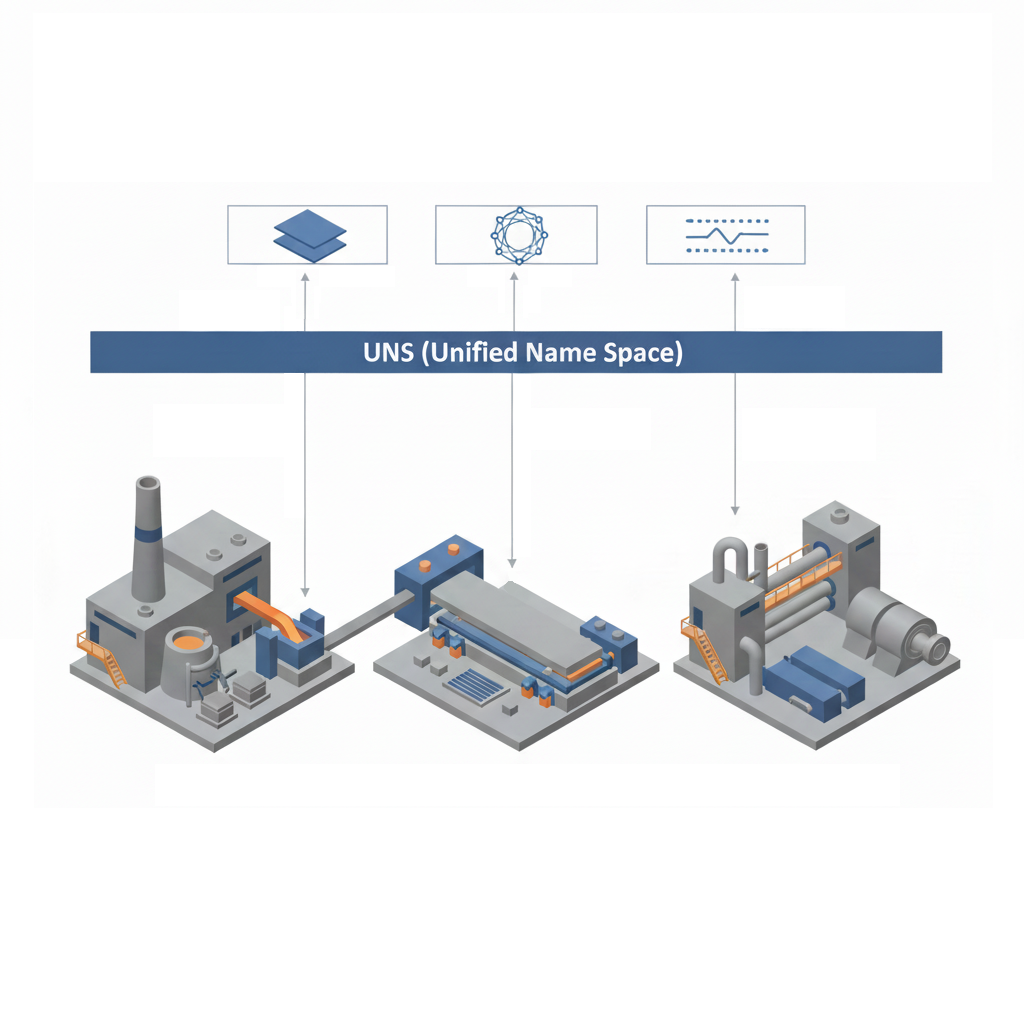
The Unified Namespace (UNS) has become one of those concepts that sounds obvious once explained and mysterious before that.
It is often described as:
- A single, shared, real-time view of what is happening in the plant.
- No point-to-point integrations.
- No system-specific data silos.
In steel, where production chains are long, tightly coupled, and extremely sensitive to timing and context, this promise is especially attractive. But like many “simple ideas”, the real challenge is not understanding what a UNS is, but making it actually work in a live steel plant.
This article looks at the real value of a UNS in steel, where it delivers concrete benefits, the difficulties that usually appear during implementation, and the key decisions that separate a successful UNS from an expensive data pipe.
What the UNS Really Changes (and What It Doesn’t)
“At its core, the UNS is not a new system. It does not replace Level 2, MES, or ERP.
What it changes is how systems talk to each other.”
Instead of:
- Level 2 sending data directly to MES
- MES exposing custom APIs to downstream systems
- Each consumer interpreting the same data slightly differently
The UNS introduces a shared, event-driven data layer, where:
- Producers publish facts about the plant
- Consumers subscribe to what they need
- No system “owns” the consumers
This sounds abstract, so let’s ground it in steel.
Real Value in Steel Plants
The Unified Namespace only adds value in steel plants when it is treated as a discipline, not as an integration shortcut. When implemented seriously, it does not hide problems or compensate for them. It exposes them.
In a typical meltshop, the same heat lives in several systems at the same time. Level 2 records one tap time, MES records another, reports show a third. None of these systems are necessarily broken. The problem is that they are all allowed to define reality independently. A UNS challenges this by forcing the organization to agree on what actually happened. When a heat is tapped, that event is published once, with a clear timestamp and context, and every system consumes the same fact. The immediate consequence is discomfort. Numbers that used to “work well enough” suddenly have to be explained.
“Disagreements do not disappear instantly, but the conversation shifts from reconciling numbers to agreeing on definitions.”
The same thing happens with duplicated logic. Steel plants are full of KPIs that are calculated multiple times by different systems, often by different teams, and quietly reconciled by ignoring small differences. Yield and energy per ton are classic examples. A UNS does not eliminate this duplication by itself, but it removes the ability to hide it. If raw measurements and derived KPIs are published separately, ownership becomes explicit. At that point, the plant has to decide which numbers are operational estimates and which ones are official. That decision is usually long overdue.
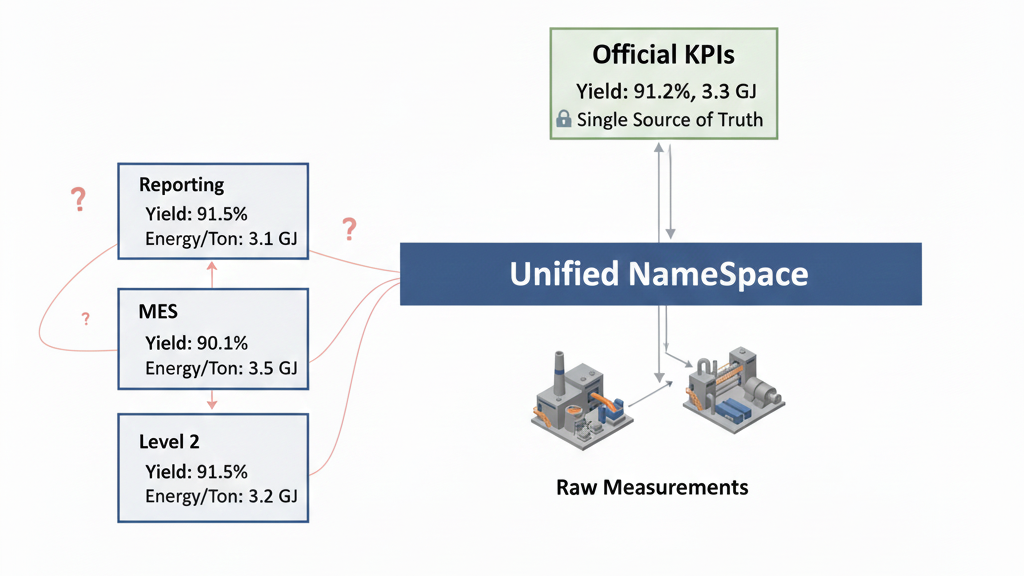
Real-time visibility is another area where expectations often exceed reality. Many plants already have real-time data, but it is locked inside Level 2 screens. Everyone else works with delays, snapshots, or reports. A UNS does not magically make people react faster, but it finally makes timely information available outside the control room. Maintenance, quality, and planning teams can subscribe to events that matter to them instead of asking for new reports every time something goes wrong. This does not eliminate coordination problems, but it removes the excuse that “the data was not available”.
Perhaps the most underestimated value of a UNS in steel is how it changes the risk profile of innovation. Advanced analytics and optimization tools rarely fail because the models are bad. They fail because connecting them to production systems is considered too risky. By design, a UNS allows new consumers to read data without touching Level 2 or MES logic. This does not guarantee success, but it lowers the barrier enough that experimentation becomes possible in real plants, not just in presentations.
Across all these examples, the common thread is not technology but clarity. The UNS does not magically fix bad models or poor definitions. What it does is make inconsistencies visible and shared. In steel plants, that clarity alone is often more valuable than any new KPI or dashboard.
Why UNS Implementations Struggle in Steel Plants
When Unified Namespace initiatives struggle in steel plants, the cause is rarely technical. In my experience, a small number of issues explain most failures. In order of importance, these are the ones that matter most.
- No clear ownership of truth: a Unified Namespace forces the question most organizations try to avoid: who owns the definition of what actually happened in the plant. When automation, IT, and operations all partially own the namespace, no one truly does. Without a clear owner for the data model, event definitions, and official values, inconsistencies accumulate and trust disappears.
- Modeling the process as it should be, not as it is: steel production is full of exceptions, workarounds, and local optimizations. When the model does not match what operators experience, downstream systems stop trusting it and rebuild logic elsewhere, defeating the entire purpose of the namespace.
- Expecting benefits without alignment and discipline: a Unified Namespace exposes inconsistencies in KPIs, timing assumptions, and responsibilities that were previously hidden. Resolving them requires alignment across teams and ongoing discipline. Plants that are not willing to have these conversations often conclude that the UNS is too complex, when in reality it is just too honest.
- Turning the UNS into a data exhaust: publishing everything feels productive, but it usually creates noise instead of insight. High-frequency signals without context, intermediate states without meaning, and values without ownership overwhelm consumers.
When these issues surface, it is tempting to blame the concept itself. In practice, the UNS is doing exactly what it should. It is revealing fragmentation that already exists. Whether that becomes a failure or a turning point depends on how the organization responds.
What Actually Matters for a Successful Implementation
After seeing several attempts to introduce a Unified Namespace in steel plants, a few patterns repeat themselves. Tooling, protocols, and platforms change, but the factors that determine success remain remarkably consistent. For me, these are the ones that matter most:
- Start from decisions, not from data: if no one can clearly explain what decision a piece of data supports, it does not belong in the UNS yet. Steel plants already have more data than they can use. The purpose of the namespace is to reduce ambiguity and reaction time, not to expose everything that happens in the process.
- Make data ownership explicit and unavoidable: every important value published to the UNS must have an owner and a clear moment when it becomes valid. It must also have a defined level of trust. Preliminary operational values and official business values are not the same thing, and mixing them undermines confidence. In practice, this often means accepting that Level 2 publishes estimates while MES publishes validated results.
- Respect the responsibilities of Level 2 and MES: a Unified Namespace does not replace existing systems, and it should not be used to work around them. In steel plants, Level 2 remains responsible for real-time control and optimization. MES is still essential for tracking, genealogy, and production confirmation. The UNS should simplify how these systems interact, not encourage logic to be duplicated elsewhere.
- Assume the data model will evolve: steel plants change continuously. Equipment is modified, products evolve, and KPIs are redefined. A successful UNS accepts this from the start. Versioning, backward compatibility, and incremental extensions are not optional. They are what allow the namespace to grow without breaking consumers or eroding trust.
- Prioritize governance over tooling: technology is rarely the limiting factor. Brokers, connectors, and dashboards are relatively easy to deploy. What matters more is enforcing naming conventions, event definitions, and modeling rules over time. Successful implementations are characterized by consistency and restraint, not by the number of integrations they support.
The uncomfortable truth is that most of these points are not technical at all. They are organizational choices. In steel plants, where complexity is real and pressure to “just make it work” is constant, a Unified Namespace only succeeds when those choices are made deliberately and defended consistently.
Final Thoughts
The Unified Namespace is not a silver bullet for the steel industry, and it should not be sold as one. Steel plants are complex by nature, and no architectural pattern will make that complexity disappear. What a UNS does, when implemented seriously, is remove the comfort of ambiguity.
In many plants, fragmentation has become normalized. Different systems tell slightly different stories about the same process, and people learn to live with it. Reports are reconciled manually, numbers are explained away, and responsibility is blurred. A Unified Namespace directly challenges this status quo by forcing the organization to agree on shared facts and shared definitions. That is why it often feels harder than expected.
“The Unified Namespace changes the conversation from system-centric to process-centric.”
The value of a UNS is not in moving data faster or in adopting modern terminology. Its real impact is cultural. It changes the conversation from system-centric to process-centric. From “this is what my application shows” to “this is what actually happened in the plant”. That shift is uncomfortable, but it is also necessary if digital initiatives are meant to scale beyond isolated improvements.
Used well, a Unified Namespace becomes a quiet but powerful foundation. It reduces integration friction, lowers the risk of innovation, and makes inconsistencies visible before they turn into operational problems. Used poorly, it becomes just another place where data is published without accountability.