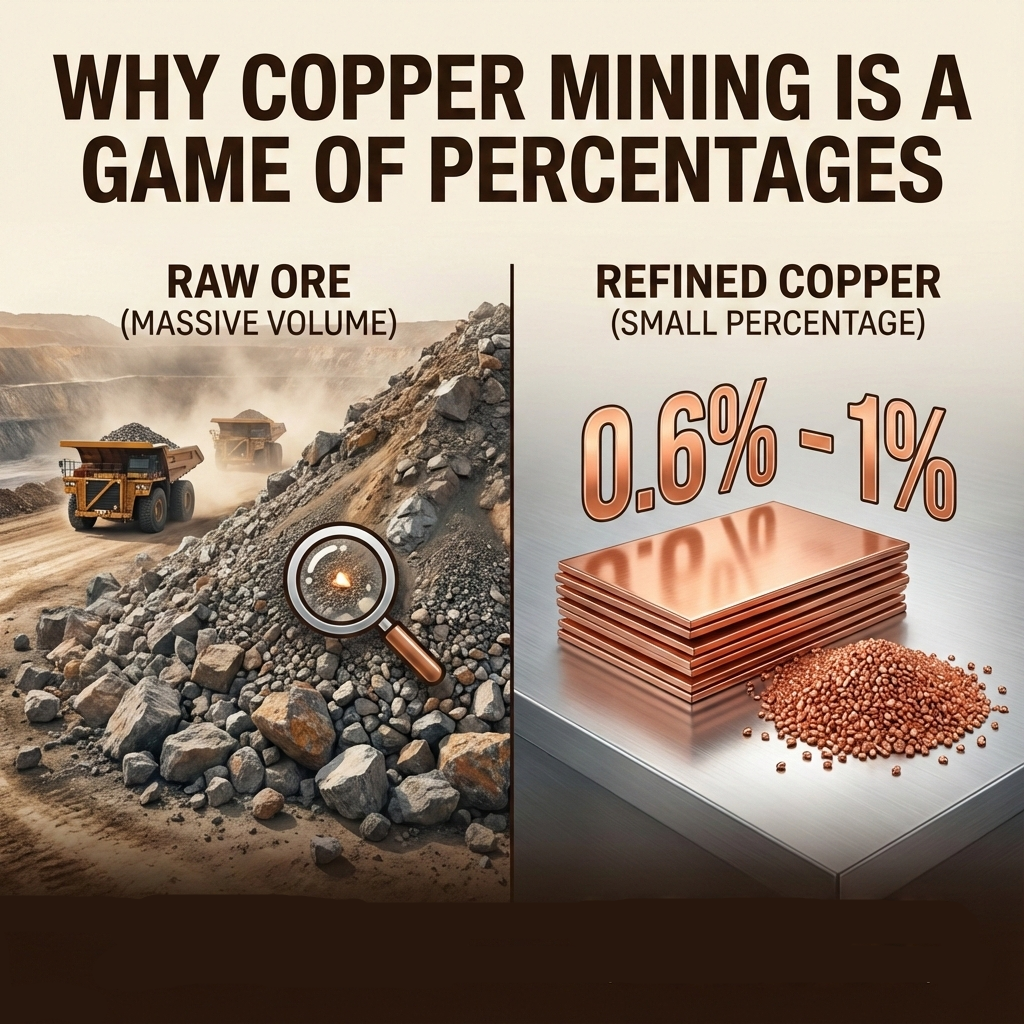
In copper mining, production does not change in big leaps. That kind of growth is rare, slow, and usually requires years of capital investment.
What actually moves the needle is much less dramatic. A 0.5 percent improvement in recovery. A small reduction in losses during concentration. A few more hours per month of stable operation in a critical asset.
Those changes look insignificant on paper. In reality, they translate directly into metal and money.
That is why copper mining is a game of percentages. And why so much effort is spent chasing fractions of a percent that quietly decide whether a mine meets its plan or not.
Let’s break it down.
The Copper Mining Process, in Simple Terms
At a very high level, copper mining is about separating a small amount of valuable metal from a very large amount of rock.
The basic chain looks like this:
1. Mining the rock
Copper ore is extracted from the ground using drilling, blasting, loading, and hauling. At this point, the rock already contains very little copper, often well below 1 percent.
2. Crushing and grinding
The mined rock is crushed and ground into a fine powder. The goal is to liberate copper minerals from the surrounding waste rock so they can be separated later.
3. Concentration
The powdered ore is processed to increase copper content. For sulfide ores, flotation is used, where air bubbles and chemicals cause copper minerals to attach and float while the waste sinks. For oxide ores, acid leaching is applied to dissolve the copper into a solution.
4. Intermediate product
This step produces either a copper concentrate, typically 25 to 35 percent copper, or a copper rich solution in the case of leaching.
5. Smelting or electrowinning
Concentrates are smelted to remove remaining impurities. Leach solutions go through electrowinning. In both cases, the output is metallic copper.
6. Refining
The final step produces high purity copper cathodes that can be sold on the market.
Where Copper Is Lost
Copper is lost gradually at every step of the process. The list below is ordered by impact, with the biggest losses first.
- Liberation losses in crushing and grinding: the biggest losses usually happen at the start. If copper minerals are not properly liberated during grinding, they remain locked in rock and pass through the entire plant unrecovered. Grinding more is expensive, so every operation accepts a level of loss here. Once copper leaves the mill trapped in rock, it is gone for good.
- Recovery losses during concentration: flotation and leaching are sensitive processes. Small deviations in air, reagents, residence time, or solution distribution can push copper into tailings or leave it undissolved. The plant keeps running, but recovery quietly drops.
- Operational losses during normal operation: downtime, startups, shutdowns, and feed changes all reduce recovery. Running outside the optimal window, even for short periods, creates losses that add up over time without being obvious in real time.
- Control and visibility losses across the process: copper is also lost when changes are detected too late. If grade shifts, equipment degradation, or process drift are only visible in reports, the response comes after the loss has already occurred. Faster feedback does not create copper, but it reduces how much slips away unnoticed.
Why Companies Chase Fractions of a Percent
In many industries, improvement comes from adding something new. A new product, a new line, a new market. In copper mining, the ore body is fixed and the infrastructure is already massive. Once a mine is built, the fastest and lowest risk way to create value is not expansion, but doing slightly better with what already exists. That is why improvements are measured in tenths of a percent rather than step changes.
A fraction of a percent in recovery or availability translates directly into metal. When a plant processes hundreds of thousands of tons per day, small gains compound continuously. They add copper without adding trucks, mills, or people. Compared to greenfield projects or major expansions, these improvements require less capital, carry less operational risk, and can be implemented incrementally. This makes them extremely attractive, even if they look unimpressive on a slide.
“You do not make money in mining by changing the ore. You make it by losing less of it.”
This way of thinking defines the economics of modern copper mining. Imagine a concentrator processing 150,000 tons of ore per day at a grade of 0.6 percent copper. That means about 900 tons of copper enter the plant every single day.
Now improve recovery by just 0.5 percent. Without mining or moving any additional rock, the plant produces 4.5 extra tons of copper per day. At a copper price of $10,000 per ton, that is $45,000 per day, or more than $16 million per year. These gains do not come from better ore. They come from running the process more consistently, reacting faster to changes, and keeping control tight. In an industry with massive capital already spent and thin margins, chasing fractions of a percent is not optional. It is how mines remain profitable.
Why a 0.5 Percent Improvement Is Hard in Reality
“On paper, a 0.5 percent improvement looks trivial. In reality, it is really hard to achieve.”
Most large copper operations are already well optimized. The obvious problems have been fixed. Equipment is sized correctly, control strategies are in place, and operators know the process well. What remains are second order effects. Small interactions between ore variability, equipment condition, and control logic that are difficult to isolate and even harder to fix.
The process itself is noisy. Ore grade and mineralogy change continuously, sometimes hour by hour. A flotation setting that works perfectly in the morning may be suboptimal by the afternoon. Grinding targets that maximize liberation for one ore type can create losses for another. Chasing a small average improvement means staying close to the optimal point all the time, not just on good days.
There is also a measurement problem. Recovery is calculated from multiple signals, often coming from different systems and with different delays. By the time a drop in recovery is visible, the event that caused it may be long over. Improving by 0.5 percent is less about finding a single big fix and more about reducing these blind spots.
Finally, many improvement levers live in the gaps between teams. Mining, processing, maintenance, and automation each optimize their own objectives. A change that improves recovery may increase wear, reduce throughput, or complicate maintenance. Getting a small net gain requires alignment, discipline, and sustained attention.
Closing Thoughts
One thing has become clear as I spend more time learning about mining. My background is still mostly in steel, and I am far from claiming deep mining expertise. But the pattern is impossible to miss.
Copper mining is an industry where small improvements have outsized impact. When fractions of a percent are worth millions, better visibility, better data, and better decision making are not nice to have. They directly affect results. Yet many losses remain hidden in delays, averages, and organizational boundaries.
This is where I see a huge opportunity for technology. Not technology for its own sake, and not another layer of dashboards, but tools that help teams detect problems earlier, react faster, and align around the same numbers. The goal is not to replace experience, but to make it more effective.
The problems are difficult, the systems are complex, and the constraints are real. That is exactly why the upside of doing things slightly better is so large.