For almost six years, I worked for a company that implemented MES for the steel industry. Projects started with understanding how the customer’s plants operated, then writing a detailed specification describing how production, quality, and logistics would work in the new system. That document drew an important line: what the standard product could handle, and what would require a change request.
Today, working on the manufacturer’s side, I see those decisions differently. The specification becomes the system operators use every shift. Its limitations become daily workarounds, and changing them can mean another discussion about scope, cost, and priorities. Both sides have valid concerns. But AI is changing one of the assumptions behind this relationship: how difficult and expensive it is to build the software itself.
Why buying made sense
For a manufacturer, building an MES meant taking responsibility for much more than production logic. Someone had to develop the application, design the screens, manage authentication and permissions, and maintain the software. The company’s business was manufacturing products, so buying an MES provided a foundation without having to develop all those capabilities internally.
The vendor also brought experience. A team that has implemented MES before knows which questions to ask: Who owns the material status? What happens when an inspection result arrives late? How will operators learn the new workflow? How do you switch systems without losing track of work in progress? That knowledge can prevent expensive mistakes, and it remains valuable even as software becomes easier to build.
The specification never captures the whole shop floor
A specification is necessary, but it will always be incomplete. Describing every production scenario before implementation is like designing a house before anyone has lived in it. The drawings can be carefully reviewed, yet someone will still discover that a door opens the wrong way when carrying groceries through it.
In manufacturing, those discoveries can affect much more than convenience. Imagine a specification that says a production order must pass inspection before moving forward. During testing, operators explain that some units may need rework while approved units continue. The system must track both groups without losing their connection to the original order. That changes production tracking, quality rules, and potentially several interfaces.
“To the vendor, this may be additional scope. To the customer, it is simply how the plant works.”
Change requests help control scope and assess the impact of changes, but when each discovery requires a commercial negotiation, learning becomes expensive and slow. Internal development does not eliminate changing requirements; it can shorten the distance between discovering a problem and fixing it.
AI changes the cost of adapting
Modern frameworks and reusable services had already made applications easier to build. AI coding tools extend that advantage by helping teams create screens, draft integration code, and write tests. The gains vary, and faster coding does not translate directly into the same reduction in total project cost. Still, the assumption that custom software is automatically too expensive deserves another look. Walker Reynolds from 4.0 Solutions makes a useful point: MES usually involves building something, whether by extending a purchased product or developing capabilities directly. The decision affects who controls that work and how easily the system can evolve.
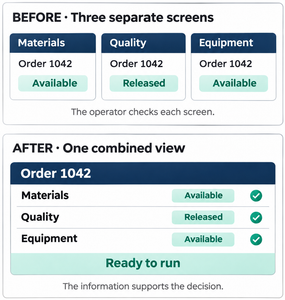
Consider an operator who opens three screens to check whether an order is ready to run. Material availability is in one, quality restrictions in another, and equipment information in a third. The operator becomes the integration layer. With AI-assisted development, a team could prototype a combined view, test it with operators, and refine it around their actual decisions. Faster feedback can produce a better workflow, while keeping development close to the people who use it. Vendors can use these tools too; the question is whether customers benefit through faster delivery and more flexible ways of working.
Building also gives manufacturers more freedom to choose their technology. An established vendor may have a platform that is difficult to modernize because many customers depend on it. One project is unlikely to change that roadmap. However, newer technology does not guarantee a better production system, and customization still needs judgment. Some local practices deserve better support; others should be simplified before anyone writes code for them.
A working demo is only the beginning
A convincing application is one thing, a dependable production system is another. Suppose MES sends a production confirmation to ERP, but the connection fails before the acknowledgment returns. Did ERP receive it? Should MES resend it? What prevents duplicate bookings? AI can help implement the solution, but someone must define the expected behavior, test failure scenarios, and support it when production is waiting.
Cybersecurity raises similar questions. If an in-house MES is compromised, who responds, restores service, and verifies that production data can still be trusted? A CIO needs concrete answers involving people, procedures, and tested recovery capabilities. A capable vendor can contribute secure development practices and incident support, but buying software does not automatically settle every question about responsibility.
An internal solution also needs a life beyond its original developer. Documentation, code review, support coverage, and ongoing maintenance belong in the budget from the beginning. The comparison has to include what it takes to operate and improve each option over years. Otherwise, an inexpensive build can become an expensive dependency on the few people who understand it.
A different relationship with vendors
I find it harder to justify handing over the whole implementation simply because the vendor owns the software platform. A more useful relationship combines internal ownership with external expertise. Manufacturers can keep purchased components where they fit, build targeted workflows where flexibility adds value, and bring in specialists for architecture, integration, security, training, and cutover. Clear system boundaries are essential for making that combination work.
A practical starting point is one workflow with a measurable problem. Improve it, validate it with operators, and demonstrate that the team can maintain it before expanding. The vendor’s value increasingly lies in the experience and support it brings to that process. AI makes greater participation possible, but manufacturers still need the capability to set priorities, understand their systems, and keep improving them after go-live.